

Inside Out is a perennial favourite at our place, and along with the sequel, is on high rotation for movie nights. When we discovered the spin-off Dream Productions, the franchise’s hold on our household only deepened.
Liking Pixar is easy, and calling their work ‘clever’ doesn’t offer any great insight. Even saying ‘it’s all in the details’ is more than a little passé. They constantly sweat the details. It’s what they do.
But there was one detail in Dream Productions that caught my eye, and stuck with me long after the fifth or sixth viewing (we have a child, repeat binge viewings are a thing). In case you haven’t seen it, Dream Productions sits between the two Inside Out films and follows the work of Riley’s dream factory, the ones who help her make sense of the day. The set up is that it’s run like a Hollywood studio, and follows the work of one director, Paula Persimmon.
Without delivering any spoilers, let’s just say Paula’s star fades somewhat, and we see her drop down the corporate pecking order. And that’s where the detail comes in. At one stage she’s ‘reassigned’ to a new office, with a piece of A4 paper used as her door sign. On the sign, her name is misspelt as Paula Persimon, with the missing ‘m’ corrected in pen.
And that’s the bit that stuck with me.
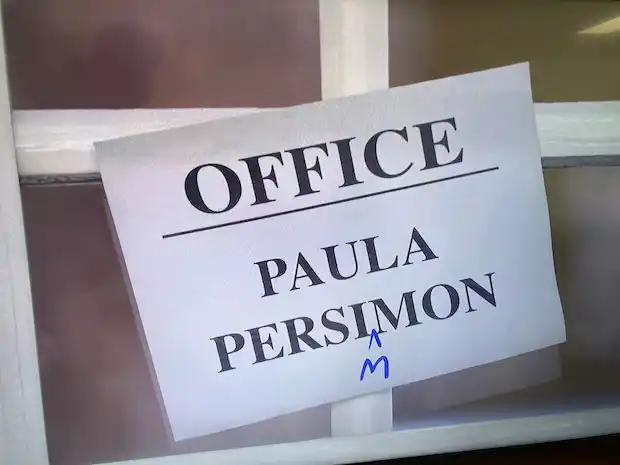
Yes, getting a name wrong is a mildly funny gag, but the whole thing spoke volumes about Paula’s situation, and the studio’s maliciousness (and possibly the scriptwriters’ experiences with the movie-making business).
Giving Paula an A4 piece of paper with her name printed on it as a door sign is one thing. Misspelling it is a classic power move. But correcting it — yeah, that takes the evil to another level.
Why? Because it says a whole lot of things. First up, “we could fix it properly, but you aren’t worth a second piece of paper, and you’re certainly not worth the few seconds it would take an intern to do it”. It also acts as a constant, public, reminder of Paula’s new lowly status.
If they’d left the name uncorrected, there’s a very good chance most people wouldn’t have noticed (other than Paula). But by correcting it, they’re subtly shouting “look at how little we value this individual”.
It’s passive aggressive public shaming that’s right at the edges of being able to be called out. Raise it and you’re the crazy, temperamental one. Ignore it and you accept your new position on the pecking order.
I’ve never worked in the movie business, but my partner has worked in TV, and even from the sidelines I could see what a brutal business that is. I can only imagine what the egos and the pressure must be like in the film industry.
And I suspect that whoever put that gag in didn’t just make it up, they’ve probably seen it — or something like it — more times than they’ve had double-shot lattes.